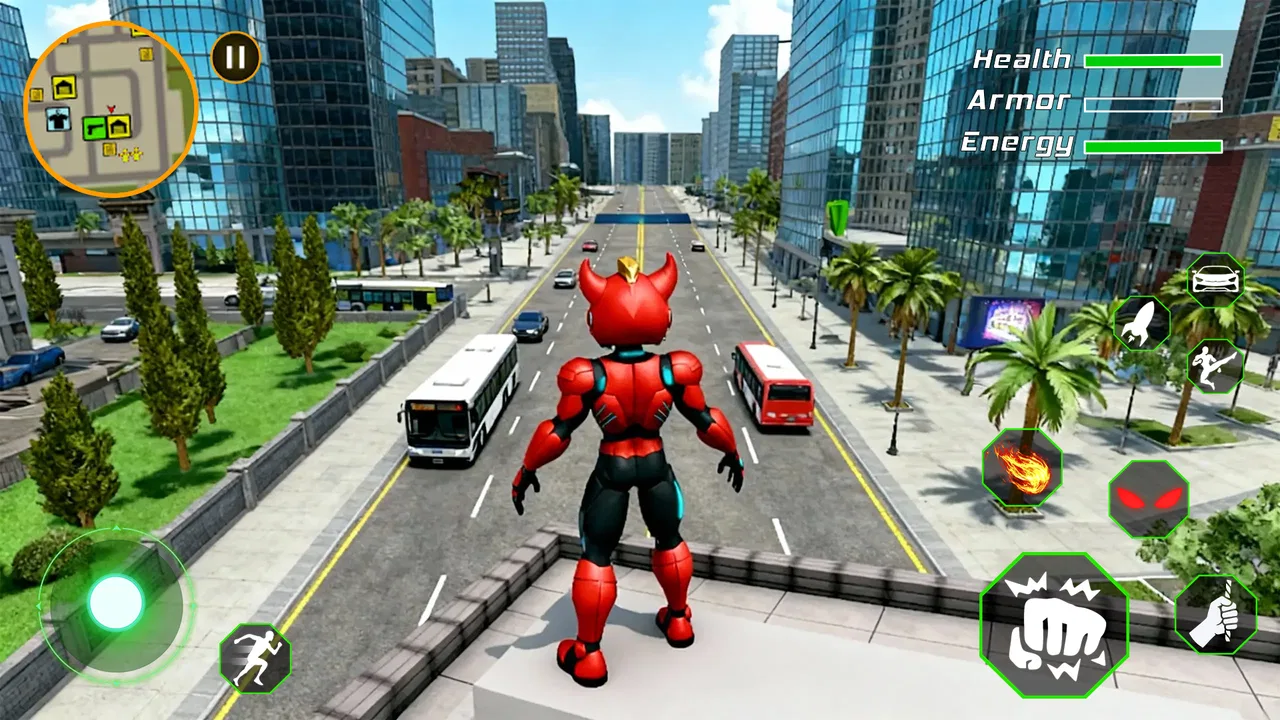
Speed Monster: City Chaos
- 4.4
- Rating
- 5.00M
- Installs
- Free
- Price

 Analysis by App-foxy
Speed Monster: City Chaos is an action game built around quick movement, missions, and deliberate mayhem. I found its appeal easy to understand from the first session: it asks me to react quickly, keep moving, and treat the city as a place to navigate aggressively rather than admire slowly. That makes it a natural choice when I want a short burst of energetic play instead of a long, story-heavy experience.
The game comes from Robocon.Std and is free to play, with an Everyone age rating. It has reached over 5 million installs and holds a 4.4 average from around 2.6 thousand ratings, which suggests that its straightforward action has found a broad audience. I would still approach it with the right expectations. This is best viewed as a fast, accessible arcade-style experience, not as a deep simulation or a carefully paced adventure.
What to expect when you start playing
The central rhythm is simple: move quickly, understand the immediate objective, and create enough disruption to make each run feel active. That simplicity is useful for first-time players because I never felt that I needed to study a complicated rulebook before trying to play. The short store description, “Speed Monster,” captures the focus better than a long explanation would: momentum matters.
You May Also Like

 Blood Strike: 2.5 Anniversary
Blood Strike’s Loadouts Turn Every Drop Into a Tactical Gamble
A close look at Blood Strike’s custom loadouts: how fast access to signature weapons reshapes its battle royale rhythm, rewards preparation, and narrows the gap between fights.

 Pandora - Music & Podcasts
Pandora’s Music Is Easy to Start, but Harder to Recover
Pandora’s strength is its low-effort path from a seed to a station. Its weak spot is how much confidence it asks you to place in connection, setup, and quiet recovery.

 8 Ball Pool
 Is Built on Rivalries, Rematches, and Routine
A close look at the rivalries, rematches, shared routines, and unanswered safety questions that turn a quick pool match into a persistent mobile community.

 Samsung Music
’s Quiet Strength Is Playing What You Already Own
Its reach comes less from spectacle than from dependable access to a personal library. That simplicity is both the app’s strongest retention engine and its ceiling.

 AccuWeather: Weather Radar
AccuWeather Review: A Quick, Clear Forecast for Everyday Decisions
For everyday plans, the best forecast is the one you can understand quickly. AccuWeather makes rain timing, radar, and local conditions easy to act on, with a few trade-offs.

 Hill Climb Racing
Why Hill Climb Racing Still Turns Crashes Into One More Run
A tiny car, a bumpy hill and one more upgrade: Hill Climb Racing keeps resurfacing because its simple chaos makes every near-miss feel personal.
More From Our News Desk



My first recommendation is to resist the temptation to rush without looking. Speed is important, but a mission is not really successful if I lose track of where I am going. I got more consistent results by checking the surroundings first, identifying the likely route, and then committing to movement. That small pause prevents the common beginner mistake of turning every attempt into random running.
The action category also tells you something about the tone. The game is designed around immediate input and visible consequences, so it suits a quick break, a commute, or a few minutes between larger tasks. It is less suitable if you are looking for a quiet puzzle, a large role-playing system, or a campaign where character development is the main reward.
Because it is free, the barrier to trying it is low. I would suggest treating the first session as a test of the movement and mission loop rather than deciding immediately whether it will become a long-term favorite. If the basic feeling of accelerating through a crowded environment and responding to objectives is enjoyable, the game has a clear reason to stay installed. If that loop feels repetitive after a few attempts, extra play is unlikely to change your opinion dramatically.
The best way to approach the opening minutes
For a first-time user, the opening goal should be control, not speed records. I spent the first attempts learning how sharply the character responds and how much room I need to change direction. That knowledge becomes more valuable than simply finishing one mission, because it helps with every later run.
A practical routine is to begin by following the objective at a controlled pace, then increase speed once the route feels familiar. This creates a useful distinction between learning attempts and performance attempts. On the first pass, I watch for turns, obstacles, and areas where momentum becomes difficult to manage. On the next pass, I try to keep the same route while moving more decisively.
This approach also makes the game less frustrating. When I failed after immediately rushing, it was not always clear whether the problem was poor timing, a misunderstood mission, or simply a bad route. Slowing down during the first attempt gives me information that can be applied instead of leaving me with a vague sense that the game is unfair.
Setting up a comfortable first session
The game supports devices running Android 7.0 or later, so it remains accessible on a wide range of Android hardware. Before starting, I would close anything that makes the phone feel sluggish and play with enough screen space to see the route clearly. I also prefer beginning with the device held in a stable position, since sudden movement is much easier to manage when the phone is not being shifted between hands.
There is no need to turn the first launch into a long preparation ritual. Start the game, read the immediate mission carefully, and pay attention to the first few seconds of movement. If the controls feel too sensitive, the answer is usually not to move faster. I found it more helpful to make smaller inputs and allow the character’s momentum to settle before changing direction again.
A useful habit is to separate navigation from destruction. When I tried to cause chaos before understanding the route, I often lost the mission’s main thread. I had better runs when I first positioned myself correctly, then used the available space to create disruption. That order keeps the action purposeful instead of turning every moment into uncontrolled movement.
Players wondering whether the game is appropriate for younger users will see an Everyone content rating. Even so, I would still consider the individual player’s tolerance for noisy, hectic action. The rating makes it broadly accessible, but the fast pace may not appeal to someone who prefers calm or highly predictable play.
From the first mission to a meaningful success
The first meaningful success is not merely reaching the end of a run. It is completing an objective while maintaining enough control to understand why the attempt worked. I recommend choosing one simple target: follow the mission instruction, keep the route in view, and avoid unnecessary detours until the objective is complete.
Once that works, repeat the same kind of run with one improvement in mind. I might try to take a cleaner route, preserve momentum through a turn, or create chaos only after reaching the correct area. Focusing on one change prevents the usual beginner problem of trying to improve everything at once.
This is where the game’s uncomplicated design becomes a strength. I do not need to remember a large inventory, compare complex character builds, or plan a long sequence of upgrades before I can feel progress. The improvement comes from my own timing and route awareness. That makes each successful attempt immediately understandable.
A realistic everyday example is a short evening break. I can start a run while waiting for dinner, finish one objective, and stop without feeling that I have abandoned a large unfinished story. If I have more time, I can continue experimenting with faster movement and more aggressive routes. That flexible session length is one of the strongest reasons I would recommend it to casual action players.
Three practical techniques that improve consistency
- Scout before committing: use the first attempt to identify the direction of the objective and the safest way to reach it. A quick mental map is more useful than immediate speed.
- Build speed in stages: begin with controlled movement, then accelerate once the next turn or target is clear. This reduces the chance of overshooting the area that matters.
- Separate the mission from the spectacle: complete the required action first, then look for opportunities to create extra chaos. This keeps entertaining behavior from interfering with the actual goal.
These techniques are not complicated, but they change how I read a failed attempt. Instead of blaming the game after a messy run, I can identify whether I moved too early, entered a turn too quickly, or ignored the mission while chasing a more dramatic moment. That kind of feedback gives the simple action loop more depth than the short description initially suggests.
What can confuse new players
The biggest source of confusion is the relationship between speed and control. The title encourages fast play, but speed alone is not a strategy. A player can move rapidly and still fail because the route was poorly chosen or because the mission required attention to a specific area. I learned to treat speed as a tool that becomes useful only after I know where I am going.
Another possible misunderstanding is expecting every chaotic action to count toward success. The game’s appeal comes from disruption, but I would not assume that the most spectacular movement is automatically the most valuable. Mission-focused play is more reliable. If an attempt becomes exciting but ends without satisfying the objective, it was entertaining practice rather than a completed success.
It is also easy to mistake repetition for a lack of progress. In a game centered on movement, repeating a route can be worthwhile when the purpose changes. The first repetition teaches the layout; the next tests timing; another may be about taking a cleaner line. I found that the same environment felt more manageable once I gave each attempt a specific purpose.
Players coming from larger open-world action games should adjust their expectations. Those alternatives often emphasize exploration, detailed stories, equipment, or broad freedom of choice. Speed Monster: City Chaos is more immediate. Its strength is that I can understand the basic objective quickly and act on it without a long introduction. Its trade-off is that players seeking extensive customization or a deep narrative may find the experience too narrow.
Where it fits among action games
Compared with a traditional racing game, this experience places more emphasis on completing missions and causing disruption than on clean laps or vehicle tuning. Compared with a story-driven action title, it removes much of the waiting and explanation before the next burst of activity. Compared with a puzzle game, it rewards reaction, spatial awareness, and movement rather than careful deduction.
That position makes it particularly useful for players who want action without a large commitment. I would choose it over a more complicated alternative when I have only a few minutes and want to start playing immediately. I would choose something else when I want a structured campaign, detailed progression, or a calmer challenge that rewards patience more than momentum.
The game’s 1.3.2 version shows that it is an actively presented product rather than an abandoned experiment, while its release date of October 9, 2025 places it among relatively recent entries in this style of mobile action. I would not use those details as a guarantee that every player will enjoy it, but they do make it reasonable to try when the concept matches your taste.
Who should install it, and who should skip it
I think it is a good fit for someone who enjoys quick objectives, energetic movement, and the satisfaction of improving a route through repetition. It also works well for casual players who do not want to learn a complicated system before reaching the fun. The Everyone rating and free price make it easy to test without turning the decision into a major commitment.
I would be more cautious if you dislike repeated attempts, chaotic environments, or games where personal control matters more than a long narrative. Players who need a strong story, a relaxing pace, or a large collection of strategic systems may be happier with another action game. The same is true for anyone who finds fast redirection tiring on a smaller phone screen.
For younger or inexperienced players, I would begin by demonstrating the difference between moving quickly and moving carelessly. That single lesson makes the early missions easier to understand. For experienced players, I would suggest treating each run like a route-optimization exercise: find the cleanest path, reduce hesitation, and decide when spectacle is worth the risk.
My recommendation after learning the loop
After spending time with it, I see Speed Monster: City Chaos as a focused action game that succeeds when I play it on its own terms. It is not trying to replace a large console-style adventure. Instead, it offers a direct cycle of movement, missions, and chaos that can be understood quickly and revisited whenever I want a lively break.
The most important tip is to let the first session be about learning rather than proving anything. Follow the objective, observe how movement behaves, and only then push for faster, more dramatic runs. That progression makes the game feel fairer and gives every failed attempt a practical lesson.
Its limitations are clear: the narrow focus may not satisfy players who need extensive variety, and the fast action can become messy when I stop paying attention to the mission. Still, those weaknesses are closely tied to its identity. The game is enjoyable precisely because it gets to the action quickly and does not bury the main idea under unnecessary complexity.
My final recommendation is straightforward: install it if you want a free, accessible Android action game for short sessions and enjoy improving through movement. Give it a fair first try by prioritizing control over speed. If that first successful mission leaves you wanting to take a cleaner route or create a bigger scene next time, you have found exactly the kind of compact action loop this game is designed to provide.
FAQs for Speed Monster: City Chaos
01What is Speed Monster: City Chaos about?
Speed Monster: City Chaos is a high-octane racing game where players navigate through chaotic city streets. The game features intense races, a variety of vehicles, and challenging missions. Players can customize their cars and compete against others to climb the leaderboards. The game is designed for adrenaline junkies who enjoy fast-paced action.
02Is Speed Monster: City Chaos free to play?
Yes, Speed Monster: City Chaos is free to download and play. However, it includes in-app purchases for players who wish to enhance their gameplay experience. These purchases can range from cosmetic items to boosters that aid in progressing through levels more quickly.
03What are the system requirements for Speed Monster: City Chaos?
For Android users, Speed Monster: City Chaos requires Android 5.0 and up. iOS users need iOS 11.0 or later. The game is optimized for both smartphones and tablets, ensuring smooth gameplay and high-quality graphics across devices. A stable internet connection is recommended for the best experience.
04Can I play Speed Monster: City Chaos offline?
Speed Monster: City Chaos primarily requires an internet connection for downloading updates and accessing multiplayer features. However, there are certain modes and levels that can be played offline, allowing users to enjoy the game even without internet access. Check the game settings for offline options.
05How can I report bugs or issues in Speed Monster: City Chaos?
If you encounter any bugs or issues while playing Speed Monster: City Chaos, you can report them through the app's support section. Go to the settings menu and select 'Contact Support' to send details about the issue. The developers are active in addressing player concerns to improve the gaming experience.
Pros
- Stunning graphics with realistic cityscapes.
- Intuitive controls for easy maneuverability.
- Wide variety of vehicles to unlock and customize.
- Regular updates with new challenges and maps.
- Engaging multiplayer mode for competitive play.
Cons
- Requires a stable internet connection.
- In-app purchases can be pricey.
- Some ads are intrusive during gameplay.
- High battery consumption on older devices.
- Occasional lag on lower-end phones.

Speed Monster: City Chaos
Gallery